Lumped Vortex Method Undergraduate Research Project
Development of a 2D Corrected Lumped Vortex Method to Model the Forces on a Pitching Aerofoil Using Steady CFD Data
In the 3rd year of my undergraduate degree, I undertook a modelling-based individual research project regarding the prediction of aerodynamic forces on a pitching aerofoil.
To evaluate an aerofoil aerodynamically, there are highly accurate methods such as unsteady Computational Fluid Dynamics (CFD) simulations. However, these are resource intensive, expensive to run and extremely lengthy. On the other hand, there are simpler alternatives such as unsteady lumped vortex methods. While these may only take a few seconds to run, there tend to be large discrepancies between their prediction and the solution, suggesting poor accuracy.
In this project, using MATLAB, I wrote a 2D unsteady lumped vortex method to calculate various forces and moments acting on a pitching aerofoil. I also ran steady CFD simulations to gather pressure distribution data at fixed incidences, to subsequently apply several correction techniques to improve the accuracy of the method.
The corrected results were compared against unsteady CFD simulations, and it was found that the lumped vortex method was able to predict the lift coefficient and closely match the CFD results with high accuracy. Similarly, it was able to capture key features and magnitudes of the moment coefficient. Finally, once the steady CFD database was established (~15-20 mins per run, one per angle), the lumped vortex simulations only took seconds to run, significantly outpacing the unsteady CFD runs which took hours to complete, making its accuracy all-the-more impressive.
 Chordwise shear distribution of the aerofoil over various incidences. When Cf < 0, the flow is detached. The project looked at three different scenarios: fully detached, semi-detached and fully attached.
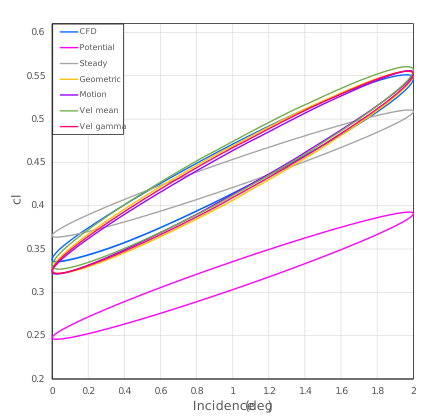 Example result of the calculated lift coefficient of a pitching aerofoil using different methods at 0° incidence (attached flow). The resulted yield by hours-long unsteady CFD (blue ellipse)are closely matched by different correction techniques of the lumped vortex method. The original uncorrected model is also displayed in magenta.
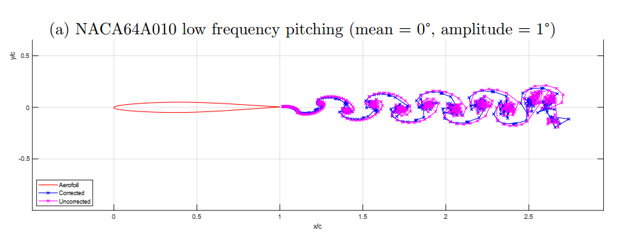 Simulation output: Wake shed behind a pitching NACA64A010 aerofoil.